Last updated on March 17th, 2026 at 01:12 pm
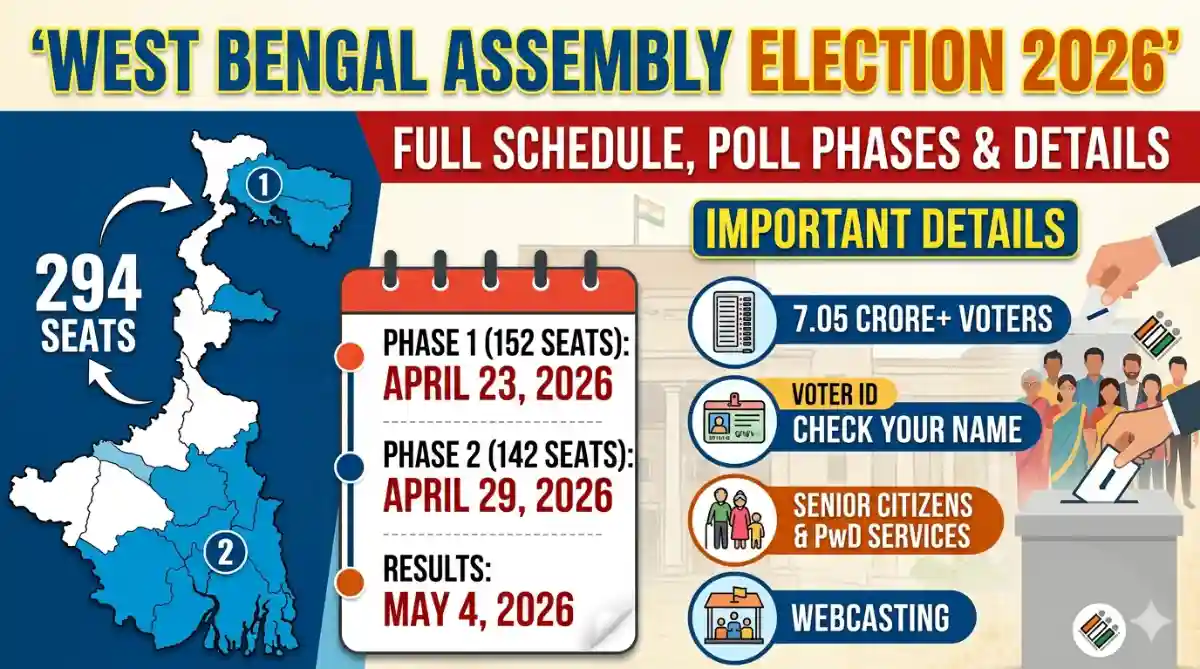
The West Bengal Assembly Election Date 2026 has been officially announced by the Election Commission of India (ECI). This much-awaited election will decide the representatives for all 294 constituencies of the West Bengal Legislative Assembly. Citizens across the state are gearing up to cast their votes in a democratic exercise that ensures the people’s voice shapes the governance of West Bengal.
Elections in West Bengal are always a significant event in Indian politics, and the 2026 assembly elections promise to be no different. Political parties, candidates, and voters are already preparing for an intense phase of campaigning, discussions, and debates. This article provides a complete overview of the West Bengal Assembly Election Date 2026, including phase-wise schedules, nomination procedures, polling dates, and counting details.
Short Overview of West Bengal Assembly Election 2026
| Election Detail | Information |
|---|---|
| Election Name | West Bengal Assembly Election 2026 |
| Conducting Authority | Election Commission of India |
| Official Website | https://ceowestbengal.wb.gov.in/ |
| Total Constituencies | 294 |
| Election Phases | 2 Phases |
| Phase 1 Seats | 152 Constituencies |
| Phase 2 Seats | 142 Constituencies |
| Polling Dates | 23 April 2026 & 29 April 2026 |
| Counting Date | 04 May 2026 |
| Election Completion | 06 May 2026 |
West Bengal Assembly Election Schedule 2026 (Phase Wise)
The Election Commission of India has released the official poll schedule for the west bengal assembly election date 2026. The election will be conducted in two phases to ensure smooth voting across the state.
This system helps the administration manage security, polling staff, and election infrastructure properly.
Below is the detailed phase-wise schedule.
West Bengal SIR 2026 Final List
First Phase Election Schedule (152 Constituencies)
The first phase will cover 152 Assembly Constituencies across different districts of West Bengal.
| Poll Event | Date |
|---|---|
| Date of Gazette Notification | 30 March 2026 (Monday) |
| Last Date for Nomination | 06 April 2026 (Monday) |
| Scrutiny of Nominations | 07 April 2026 (Tuesday) |
| Last Date for Withdrawal | 09 April 2026 (Thursday) |
| Date of Poll | 23 April 2026 (Thursday) |
| Counting of Votes | 04 May 2026 (Monday) |
| Completion of Election | 06 May 2026 (Wednesday) |
In this phase, voters from 152 constituencies will cast their votes to elect their representatives. Political parties will start their campaigns much before this date.
Second Phase Election Schedule (142 Constituencies)
The second phase will include 142 Assembly Constituencies.
| Poll Event | Date |
|---|---|
| Date of Gazette Notification | 02 April 2026 (Thursday) |
| Last Date for Nomination | 09 April 2026 (Thursday) |
| Scrutiny of Nominations | 10 April 2026 (Friday) |
| Last Date for Withdrawal | 13 April 2026 (Monday) |
| Date of Poll | 29 April 2026 (Wednesday) |
| Counting of Votes | 04 May 2026 (Monday) |
| Completion of Election | 06 May 2026 (Wednesday) |
This phase will complete the voting process for the remaining constituencies of the state.
BJP Candidate List 2026 West Bengal District Wise
Why the Election Is Conducted in Multiple Phases
The west bengal assembly election date 2026 has been divided into two phases for several practical reasons.
West Bengal is a large and politically active state. Conducting elections in multiple phases helps the Election Commission manage logistics more efficiently.
Some important reasons include:
- Security Management
- During elections, a large number of security forces are deployed. Multiple phases allow the same forces to be moved from one district to another.
- Better Administration
- Polling officials and election staff can be distributed properly across constituencies.
- Peaceful Voting
- Phased elections help maintain law and order. It also reduces the chances of election-related violence.
- Smooth Voting Process
- The Election Commission can monitor the polling process closely and handle any issues quickly.
Nomination Process for Candidates
Before the actual polling takes place, candidates must complete the nomination process.
The process begins with the Gazette Notification issued by the Election Commission. After that, candidates from different political parties or independent candidates can submit their nomination papers.
The important steps are:
- Filing nomination papers
- Verification and scrutiny by election officials
- Withdrawal of candidature if required
- Final list of candidates released
Only candidates who successfully complete this process can contest the election.
Voting Process in West Bengal Assembly Election
The voting process in the west bengal assembly election date 2026 will follow the standard election procedure used in India.
- Electronic Voting Machines (EVM)
- Voters will cast their votes using Electronic Voting Machines (EVMs). These machines ensure quick and accurate vote counting.
- VVPAT System
- Along with EVMs, VVPAT machines will also be used. VVPAT allows voters to verify that their vote has been recorded correctly.
- Polling Booths
- Thousands of polling booths will be set up across the state. These booths will be managed by trained election staff.
- Voter Identification
- Voters must carry a valid Voter ID card or approved identity proof to cast their vote.
Counting of Votes
The counting of votes for both phases will take place on 04 May 2026.
On this day, the sealed EVM machines will be opened in counting centers across the state. Election officials will count the votes in the presence of candidates and observers.
As the counting progresses, the results will be updated regularly. By the end of the day, it will become clear which political party or alliance has won the majority of seats.
Formation of the New Government
After the counting process is completed, the party or alliance that wins the majority of seats in the 294-member assembly will form the government.
A majority requires at least 148 seats in the assembly.
The elected members will then choose the Chief Minister of West Bengal, who will lead the state government for the next five years.
Importance of Voting for Citizens
Voting is one of the most important rights in a democracy.
The west bengal assembly election date 2026 gives citizens the opportunity to choose leaders who will work for the development of the state.
When people participate in elections, they help strengthen democracy.
Some key benefits of voting include:
- Choosing responsible leadership
- Ensuring government accountability
- Participating in democratic decision making
- Supporting development and governance
Every eligible voter should participate in the election and exercise their democratic right.
Conclusion
The announcement of the west bengal assembly election date 2026 marks the beginning of an important democratic process in the state. The election will be conducted in two phases, covering all 294 constituencies.
Polling will take place on 23 April 2026 and 29 April 2026, while the counting of votes will be held on 04 May 2026. The entire election process will be completed by 06 May 2026.
Millions of voters across West Bengal will participate in this election to choose their representatives. The results will decide the political direction of the state for the next five years.
Citizens are encouraged to stay informed, verify their voter details, and take part in the election process responsibly.
The west bengal assembly election date 2026 is not just a political event. It is an opportunity for people to express their voice and shape the future of West Bengal.

Babusona Mondal
I am Babusona Mondal, a government schemes content writer with 4+ years of experience on platforms like mywestbengal.com. I also have 7+ years of practical experience with CSC e-Gov, CSP, and the West Bengal Labor Department.


